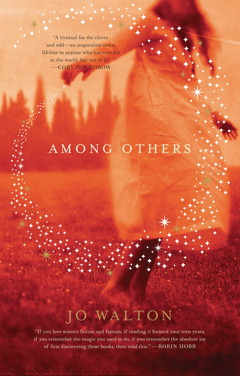
 Today was the official publication date of Jo Walton’s new novel, Among Others. It’s a fantastic book, one of the best I’ve read in a long time. It’s about fairies, and magic — and growing up reading science fiction and fantasy. That sounds like a dissonant combination, but oh does it ever work.
I managed to lay hands on an advance bound manuscript because Jennifer and I actually met Jo Walton at SFContario last November. In the dealers’ room on day one of the convention, Jennifer managed to sing the praises of one of Walton’s earlier novels, Tooth and Claw (which is the kind of novel Anthony Trollope would have written, if Trollope wrote about dragons), without realizing that Jo herself was sitting right in front of her. (That’s got to be a satisfying thing to happen to an author.) By the end of the convention Jo was offering to sell us all her other books for a low price and to sign them all for Jen as well. That included the advance bound manuscript for Among Others. Looking at the cover blurb, I said, “This sounds really neat.”
I had no idea just how good it was going to be.
On the surface, Among Others is a series of journal entries over a six-month period by the protagonist, 15-year-old Welsh teenager Mori, as she starts her first year at a private boarding school. But from the first it is abundantly clear that Something Is Not Right — Mori has run away from her mother, she walks with a cane, and her twin sister, whom we see in the prologue, is referred to only in the past tense — but what that Something is comes in dribs and drabs, among the day-to-day minutiae of meeting her father’s family and dealing with classmates and schoolwork at her English (horror!) school. Also, there are fairies, who have plans for her; and she can do magic, but is afraid to do so for fear of attracting the attention of her mother, who sounds like some kind of sorceress. What the fairies’ plans are, what her mother did to cause her to flee, what happened to her sister, how she got crippled — these are all revealed in the end, but for most of the book it’s in the background, as Mori tries to put her life back together, in a new setting, surrounded by new people, after a terrible trauma.
At the same time, Mori spends an awful lot of the novel talking about science fiction. She consumes novels like candy; her journal entries are full of her reactions to virtually every science fiction novel and collection published by the 1970s. Her writing is peppered with references to Tolkien and Le Guin; she even calls one of the fairies Glorfindel. Among Others is set in 1979 and 1980, so Mori reads The Hitch Hiker’s Guide to the Galaxy or early work by C. J. Cherryh not as classics but as new work.
From Gary Wolfe’s review on Locus Online:
What is remarkable is not only how Walton evokes the capacity of fiction to preserve wonder and hope in a dispiriting world, but how she conveys this, as with the Hardy comment, in the opinionated but not quite fully-formed voice of a teenager discovering these works at the tail-end of the 1970s, which comes across as a kind of Golden Age of SF in Mori’s narrative, with Tolkien already established as canonical, Heinlein just entering his cranky late phase, and Le Guin, Zelazny, and Tiptree, along with the historical novels of Mary Renault, coming as astonishing revelations to a young British reader.
It’s hard, in fact, not to think of Jo’s many blog entries about books at Tor.com: there is clearly a lot of Jo in Mori, and Mori in Jo. Among Others is at least partially autobiographical, and while Jo and Mori are both Welsh and the same age, both read voraciously and fast and both walk with a cane, it would be dangerous to assume that Jo got into any magical duels as a child, or can show me where the fairies are. (Alas.)
This is a fairy tale, and it’s a novel about reading science fiction. But as the title suggests, with its double meaning, it’s also a novel about being an outsider. Sherwood Smith has a lot to say about the repeated presence of liminality in Among Others: a Welsh girl in an English school, a practitioner of magic who can see fairies in a mundane world, leaving her mother’s family and getting acquainted with her father’s.
Being an outsider, of course, is also something that most science fiction fans can relate to. Growing up reading science fiction means living somewhere else — in Middle-earth or Xanth, on Pern or Terminus or Mars. It can be a lonely life if there’s no one around who gets you. Sure, a couple of my classmates read Piers Anthony and Anne McCaffrey in junior high, but finding someone who could get the obscure Tolkien references — by high school I was writing notes to myself using the Tengwar — was an impossible task, to say nothing of finding anyone else who read Asimov or Niven. Indeed, like Mori, my main source of science fiction was my father; like Mori, I’m a second-generation science fiction reader. But unlike Mori, I couldn’t cast a spell to find, as she eventually does, a circle of people like her: a science fiction reading group.
(Indeed, though Jen and I met because of our mutual interest in snakes, what truly sealed the deal, I think, was our mutual interest in science fiction: she saw my library. And it was only last year — at the tender age of 38 — that I started attending science fiction conventions for the first time. I’ve long felt out of place in virtually every social and work context, a square peg always finding round holes; it may only be in science fiction fandom that I can find a karass, to use the Vonnegut term Walton borrows, of my own.)
As Patrick Nielsen Hayden, Walton’s editor at Tor Books, writes in a blog entry on both Tor.com and Making Light:
I am not Welsh or female, I do not walk with a cane, and I do not have a dead sibling or a parent who wants me dead. I never attended a boarding school, my family is far-flung and American, and I have never (to the best of my knowledge) conversed with fairies. And yet to a startling extent Among Others feels like a book about the experience of being me when I was, like Mori, fifteen. This turns out to be a fairly common reaction to reading Walton’s novel, at least among the kind of people I tend to know. It is quite possibly the best thing I have ever read about the way people of our ilk, when young, use books and reading to — in the words of Robert Charles Wilson — “light the way out of a difficult childhood.”
If you grew up reading science fiction and fantasy like I did, you will resonate like a tuning fork when you read this. You have to read this. I’m not kidding. If you don’t believe me, read this excerpt. If that’s not enough to make you run out and buy it, I don’t know what to do with you. It’s so good, if it doesn’t make next year’s Hugo and Nebula ballots, I will be most put out.
More reading: Cory Doctorow’s review on Boing Boing; Jo Walton’s LiveJournal.
- Among Others by Jo Walton
- Amazon.ca • Amazon.com • Amazon.co.uk
 I got a good look at the audience when the lights came up. We’re in our late thirties, and we were among the younger viewers. The 18-25 demographic was not much in attendance. It occurred to me that the bulk of this audience was old enough to remember